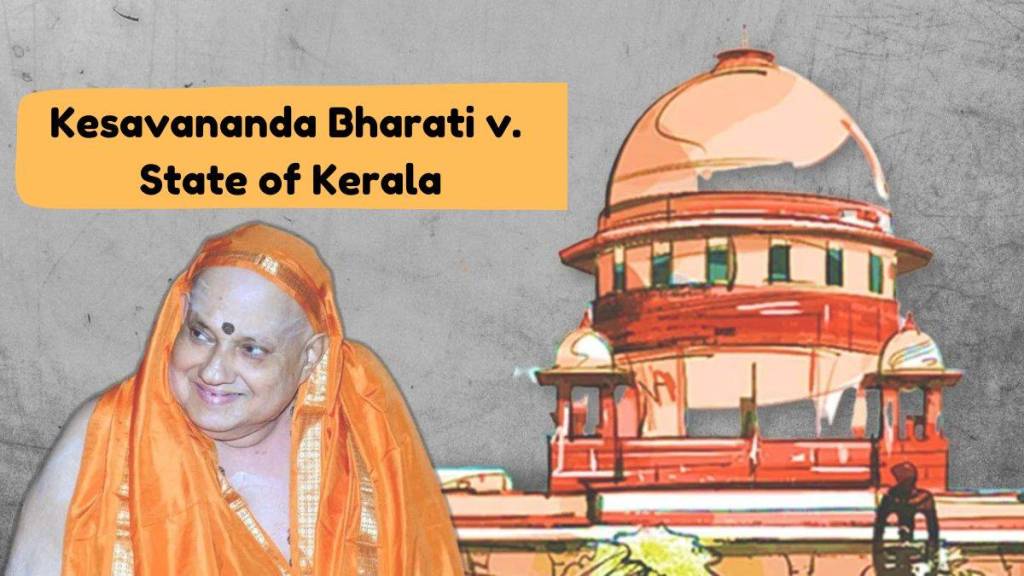
Can Parliament change the Constitution?
The answer is yes. But can it change everything?
Can Parliament abolish democracy? Remove free elections? Eliminate judicial review? Replace the Constitution with an entirely different system of government?
These questions lay at the heart of one of the most significant constitutional cases in India’s history—Kesavananda Bharati v. State of Kerala (1973).
The Supreme Court’s answer changed the course of Indian democracy forever. While Parliament has extensive powers to amend the Constitution, those powers are not unlimited. The Court held that Parliament cannot alter or destroy the Basic Structure of the Constitution.
This decision continues to shape every major constitutional amendment in India and remains the cornerstone of Indian constitutional law.
Case at a Glance
| Particular | Details |
|---|---|
| Case | Kesavananda Bharati v. State of Kerala |
| Court | Supreme Court of India |
| Citation | (1973) 4 SCC 225 |
| Date of Judgment | 24 April 1973 |
| Bench Strength | 13 Judges (Largest Bench in Indian History) |
| Majority | 7:6 |
| Landmark Principle | Parliament can amend any part of the Constitution but cannot destroy its Basic Structure. |
Historical Background
To appreciate the significance of this case, it is important to understand the political and constitutional developments that led to it.
When the Constitution came into force in 1950, it guaranteed several Fundamental Rights, including the Right to Property under Articles 19(1)(f) and 31. At the same time, the Constitution also contained Directive Principles of State Policy, which encouraged the State to reduce economic inequality and implement land reforms.
After Independence, the Government introduced several land reform laws to abolish the zamindari system, impose ceilings on land holdings, and redistribute agricultural land to landless farmers. These reforms aimed to achieve social and economic justice but often affected the property rights of landlords, religious institutions, and private individuals.
Many of these laws were challenged before the Supreme Court on the ground that they violated Fundamental Rights. This led to a constitutional conflict between Parliament and the Judiciary over the extent of Parliament’s power to amend the Constitution.
Constitutional Developments Before the Case
Several landmark cases gradually shaped this constitutional debate.
1. Shankari Prasad v. Union of India (1951)
The Supreme Court held that Parliament could amend any part of the Constitution, including Fundamental Rights. The Court reasoned that a constitutional amendment made under Article 368 was different from an ordinary law under Article 13.
2. Sajjan Singh v. State of Rajasthan (1965)
The Court reaffirmed the decision in Shankari Prasad and again recognised Parliament’s broad amending power.
3. Golaknath v. State of Punjab (1967)
This judgment marked a dramatic shift.
The Supreme Court held that Parliament could not amend Fundamental Rights, as constitutional amendments fell within the meaning of “law” under Article 13.
The decision significantly restricted Parliament’s powers and created practical difficulties for implementing social welfare and land reform legislation.
To overcome the Golaknath decision, Parliament enacted several constitutional amendments, which eventually became the subject of the Kesavananda Bharati case.
Facts of the Case
Swami Kesavananda Bharati was the head (Shankaracharya) of the Edneer Mutt, a Hindu religious institution in Kasaragod, Kerala. The Mutt owned large areas of agricultural land used for religious and charitable purposes.
The Kerala Government enacted the Kerala Land Reforms Act, 1963, which imposed limits on land ownership and empowered the State to acquire surplus land.
Since the Act substantially affected the Mutt’s property, Kesavananda Bharati filed a writ petition under Article 32 before the Supreme Court, alleging that the Act violated several Fundamental Rights, including:
- Right to Property
- Freedom of Religion
- Right to manage religious affairs
While the case was pending, Parliament passed the 24th, 25th, and 29th Constitutional Amendments, each of which sought to strengthen Parliament’s amending power and protect land reform laws from judicial review.
Consequently, what began as a dispute over property rights evolved into the most important constitutional case in Indian history.
Constitutional Amendments Under Challenge
Twenty-Fourth Constitutional Amendment Act, 1971
This amendment was enacted primarily to nullify the effect of the Golaknath judgment.
It:
- expressly stated that Parliament had the power to amend any provision of the Constitution;
- made it mandatory for the President to give assent to constitutional amendment bills; and
- clarified that Article 13 would not apply to constitutional amendments.
Twenty-Fifth Constitutional Amendment Act, 1971
This amendment sought to give greater importance to certain Directive Principles over Fundamental Rights.
It also inserted Article 31C, limiting judicial review in certain situations and reducing the protection previously available under the Right to Property.
Twenty-Ninth Constitutional Amendment Act, 1972
This amendment placed two Kerala land reform statutes into the Ninth Schedule, thereby attempting to shield them from constitutional challenges before the courts.
Constitutional Provisions Involved
The Court examined several important constitutional provisions, including:
- Article 13 – Laws inconsistent with Fundamental Rights.
- Article 14 – Equality before law.
- Article 19 – Protection of freedoms.
- Article 25 – Freedom of religion.
- Article 26 – Freedom to manage religious affairs.
- Article 31 – Right to Property (as it then existed).
- Article 31C – Protection of laws implementing certain Directive Principles.
- Article 32 – Right to constitutional remedies.
- Article 368 – Power of Parliament to amend the Constitution.
The interpretation of Article 368 became the central issue before the Court.
Issues Before the Supreme Court
The Supreme Court framed several constitutional questions, including:
- Does Article 368 give Parliament unlimited power to amend the Constitution?
- Can Parliament amend or take away Fundamental Rights?
- Is there any implied limitation on Parliament’s amending power?
- Are constitutional amendments subject to judicial review?
- Are the 24th, 25th and 29th Constitutional Amendments constitutionally valid?
These issues required the Court to balance parliamentary sovereignty with constitutional supremacy.
Arguments of the Petitioners
The petitioners, led by the eminent constitutional lawyer Nani Palkhivala, advanced several important arguments.
Parliament Has Limited Powers
The Constitution grants Parliament the power to amend, not destroy, the Constitution. An amendment implies improvement or modification, not complete replacement.
The Constitution Is Supreme
Parliament itself derives its powers from the Constitution. Therefore, it cannot claim unlimited authority over the very document that created it.
Fundamental Rights Cannot Be Destroyed
If Parliament possessed unlimited amending power, it could abolish equality, liberty, freedom of speech, religious freedom, and even democracy itself. Such a result would defeat the purpose of a written Constitution.
Judicial Review Must Continue
The petitioners argued that judicial review is an essential feature of constitutional governance. Without judicial review, there would be no effective check on arbitrary constitutional amendments.
Arguments of the Union Government
The Government presented an entirely different constitutional philosophy.
Parliament Represents the Will of the People
Since Parliament is democratically elected, it should possess broad authority to amend the Constitution to meet changing social and economic needs.
Article 368 Contains No Express Limitation
The Constitution nowhere states that Parliament’s amending power is limited. Therefore, the Court should not impose restrictions that the Constitution itself does not mention.
Social Justice Requires Broad Amending Powers
The Government argued that land reforms, poverty alleviation and redistribution of resources would become impossible if every constitutional amendment were subjected to judicial interference.
The Legal Debate
The Court was not merely deciding a dispute about land reforms.
It had to determine a much larger constitutional question:
Can the Constitution legally destroy itself?
If Parliament possessed unlimited power under Article 368, it could theoretically abolish elections, suspend judicial review, remove federalism, establish a dictatorship, or even repeal the Constitution itself.
The majority of the Court concluded that while Parliament may amend every provision of the Constitution, it cannot alter its essential identity.
This principle came to be known as the Basic Structure Doctrine.
The Basic Structure Doctrine
The Supreme Court held that certain fundamental features give the Constitution its identity.
These essential characteristics cannot be destroyed even by a constitutional amendment.
The Court intentionally declined to provide an exhaustive list because constitutional law evolves over time. Instead, it stated that future courts would identify additional basic features whenever necessary.
Some recognised components of the Basic Structure include:
- Supremacy of the Constitution
- Rule of Law
- Judicial Review
- Separation of Powers
- Federalism
- Democracy
- Republican form of Government
- Secularism
- Independence of the Judiciary
- Free and Fair Elections
- Parliamentary system of Government
- Balance between Fundamental Rights and Directive Principles
- Unity and Integrity of India
- Limited power of constitutional amendment
Judgment of the Supreme Court
After hearing arguments for nearly five months—the longest hearing in the Court’s history at that time—the thirteen-judge bench delivered eleven separate opinions.
By a narrow 7–6 majority, the Court held:
Parliament Can Amend the Constitution
The Court overruled the restrictive interpretation adopted in Golaknath and recognised that Parliament may amend every provision of the Constitution, including Fundamental Rights.
Parliament Cannot Destroy the Basic Structure
The power to amend does not include the power to destroy. Parliament cannot alter the Constitution so fundamentally that its basic identity disappears.
Validity of the Amendments
- The 24th Amendment was upheld because Parliament does possess the power to amend the Constitution.
- The 25th Amendment was upheld only in part. The Court rejected the attempt to completely exclude judicial review.
- The 29th Amendment was upheld, but laws placed in the Ninth Schedule could still be examined if they violated the Basic Structure.
Thus, the Court struck a balance between parliamentary sovereignty and constitutional supremacy.
Why Justice H.R. Khanna’s Opinion Was Crucial
Justice H.R. Khanna delivered the decisive opinion that ultimately formed the majority.
He accepted that Parliament had extensive powers to amend the Constitution, including Fundamental Rights. However, he also held that these powers were subject to inherent limitations because the Constitution’s basic framework could not be destroyed.
His opinion became the turning point of the entire case and laid the foundation for the Basic Structure Doctrine.
Importance of the Judgment
The impact of this decision cannot be overstated.
It:
- protected the supremacy of the Constitution over Parliament;
- prevented any government from legally abolishing democracy;
- strengthened judicial review as a constitutional safeguard;
- established a balance between Parliament’s amending power and the judiciary’s duty to protect constitutional values; and
- became the foundation for numerous later constitutional decisions.
Every major constitutional amendment passed after 1973 has been tested against the Basic Structure Doctrine established in this case.
Criticism of the Judgment
Despite its immense significance, the judgment has attracted criticism.
Some constitutional scholars argue that:
- the Constitution does not expressly mention the Basic Structure Doctrine;
- the doctrine gives judges excessive discretion;
- it allows the judiciary to override Parliament’s democratic mandate.
Supporters, however, argue that constitutional democracy requires limits on every organ of the State. Without such limits, even democracy could be abolished through a constitutional amendment.
Conclusion
The decision in Kesavananda Bharati v. State of Kerala represents one of the finest examples of constitutional balance.
The Supreme Court neither made Parliament powerless nor allowed it to become supreme. Instead, it recognised that while the Constitution must remain flexible enough to adapt to changing times, it must also preserve its fundamental identity.
The Basic Structure Doctrine ensures that India’s Constitution remains a living document—capable of growth and reform, yet protected from destruction. More than fifty years after the judgment, it continues to serve as the constitutional safeguard that preserves democracy, the rule of law, judicial independence, and the rights of every citizen.
For students of constitutional law, understanding this case is not merely about learning a judgment—it is about understanding the very principles that keep the Indian constitutional system intact.





 Urban Flame
Leave a comment